Structure-only Cmax.
Evidence stated plainly.
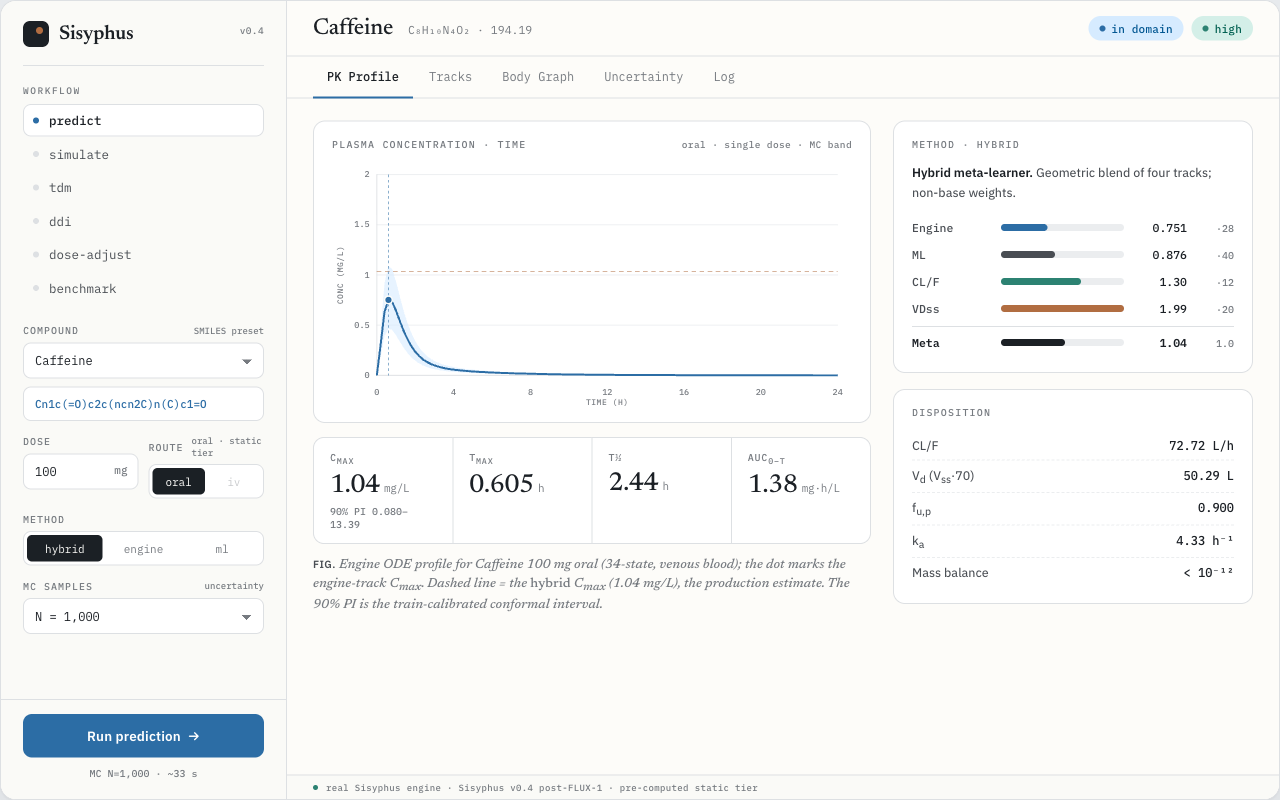
Sisyphus predicts single-dose oral Cmax from a parent-drug SMILES and dose. A separate graph-based PBPK solve provides mechanistic research outputs; those endpoints are not presented as if they came from the Cmax ensemble.
Three ideas that define Sisyphus
The design choices that make it extensible and honest, not just another PBPK script.
The body is a graph
Organs are nodes; vessels, transit, and clearance are typed edges. The ODE system is derived from graph topology — you extend the model by editing YAML, never the engine.
Intervals keep their meaning
Parameter Monte Carlo and empirical model-residual bands are separate outputs. The current residual band is development evidence, not an independent conformal guarantee.
The engine knows types, not identities
No organ or drug names live in the engine. Identity lives in data, so new organs, enzymes, and routes never require an engine change.
One production question, one evidence view
The public console is intentionally narrow: oral Cmax prediction and transparent development-benchmark inspection. Open the console →
Retrospective development evidence
N=107 is compound-disjoint from audited fitted-model training, but it was repeatedly used for system selection and calibration. It is therefore development data, not an independent holdout.
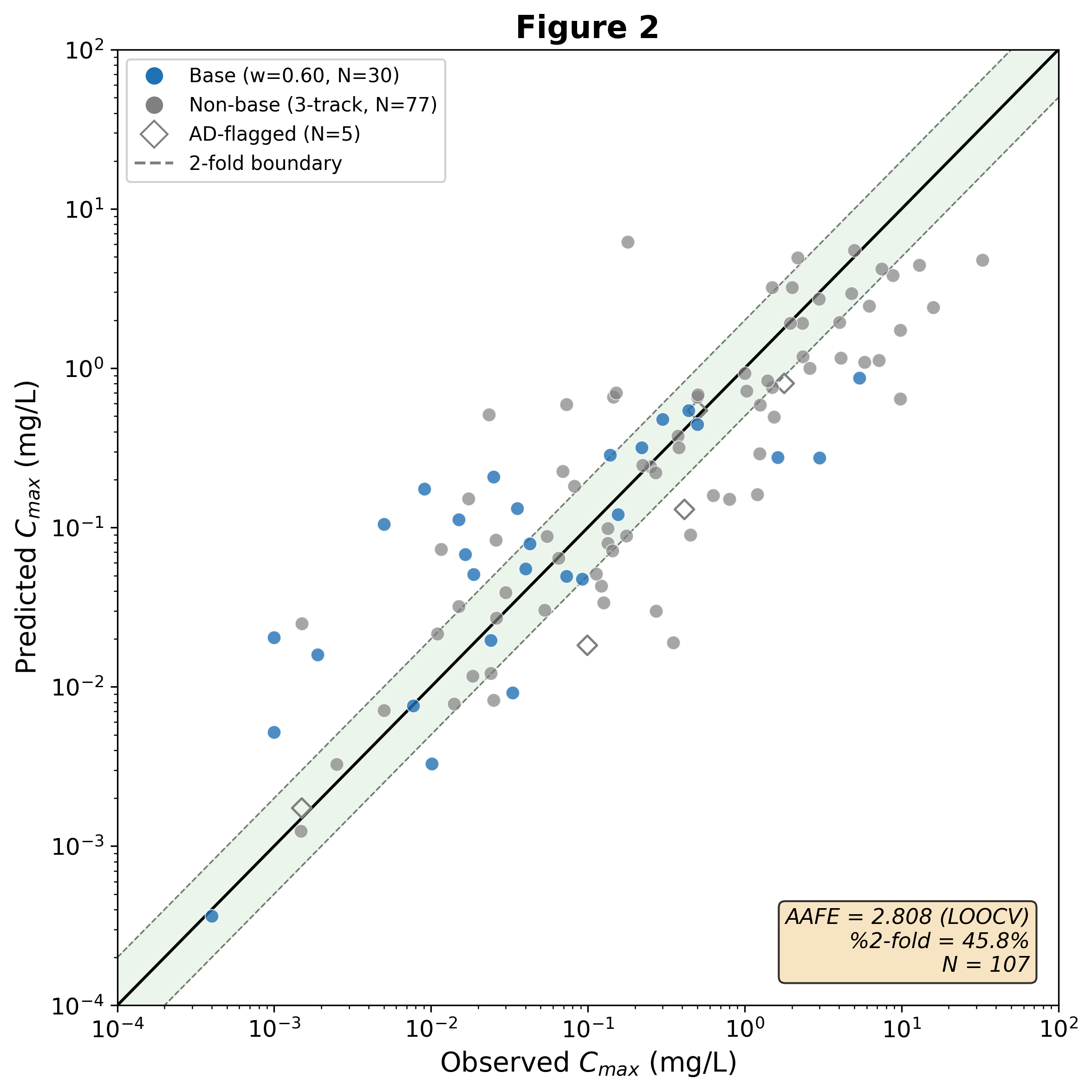
| Track | AAFE | within 2-fold |
|---|---|---|
| Meta · development | 2.74 | 44.9% |
| Engine only | 4.28 | 27.1% |
| ML only | 3.00 | 43.0% |
| Meta, structurally in-scope | 2.79 | 42.0% |
A four-track meta-learner blends a mechanistic engine, a data-driven ML Cmax, a CL/F analytical, and a conditional VDss track. Prospective FDA NMEs (2024–25) are harder still at AAFE 3.27 — generalization, stated plainly.
Or run it from the command line
The console is one face of a Python library + CLI.